Idiap and OPPAL Association Launch WolfCam to Reduce Human–Wolf Conflict
The growing tension between species conservation and the protection of pastoral livelihoods highlights the need for innovative, non-lethal tools to support sustainable coexistence. To date, OPPAL management’s efforts have relied on the so-called “Monitoring and Deterrence” (MonDe) approach, which mobilizes volunteers and civil servants to monitor wolf presence near herds at night using thermal cameras and deter them. While this method works well, one team can only monitor a single herd at the time. It has therefore become necessary to scale up and automate the system so that one team could potentially oversee several herds in different locations. Moreover, livestock owners and shepherds should be empowered and gain greater control over the situation around their herd: rather than reacting to challenges, the system will involve them in the management and monitoring process.
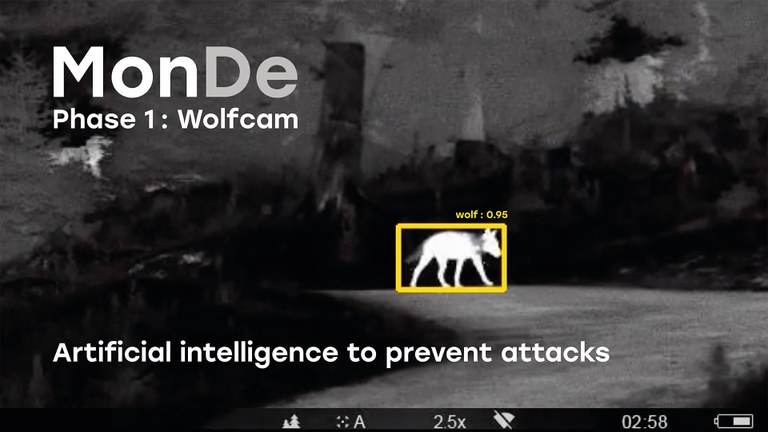
Under the leadership of senior research scientist Jean-Marc Odobez, head of Idiap’s Perception and Activity Understanding group, and thanks to the support of Fondation Valery, the work of OPPAL and Idiap has resulted in “WolfCam”, an advanced wildlife-tracking system. The main idea is to integrate a network of thermal cameras deployed in the field where herds are present with computer-vision and machine-learning algorithms capable of detecting wolves in real time, including at long distances and under low-visibility conditions. The system leverages OPPAL’s large collection of thermal video data, which has been the subject of a substantial and ongoing annotation effort to label wolves and other animals, enabling the training of models capable of recognizing when a wolf is approaching a herd. When this happens, it sends an alert through a digital interface to the appropriate responders. This allows shepherds and protection teams to focus on high-risk areas and take early action using deterrent measures to protect their livestock.
In addition to its immediate operational benefits, “WolfCam” will provide a scalable and cost-efficient alternative to reduce human-wildlife conflicts. In fact, the system contributes to biodiversity preservation while supporting the long-term sustainability of pastoral livelihoods.
Through this initiative, Idiap and the OPPAL Association aim to advance science-based solutions that facilitate coexistence between human activities and large predators, transforming a long-standing challenge into a viable and sustainable, long-term management approach.