AI in Healthcare: Ensuring Reliable and Locally Relevant Tools for Patients in Valais
Funded through the Canton of Valais Interinstitutional Call 2025, the project VALIDATE-H was led by Dr André Anjos, Head of the Medical AI Group at Idiap. The consortium team included Oscar Jimenez-del-Toro and Roberto Pulvirenti from Idiap, Elia Pacioni and Davide Calvaresi from HES-SO Valais-Wallis, and Luc Fornerod from OVS. The project combined complementary expertise from all partners: Idiap in AI, computer vision, medical imaging, and software engineering; HES-SO Valais-Wallis in distributed and explainable AI; and OVS in healthcare, population data, and health statistics, ensuring alignment with local needs.
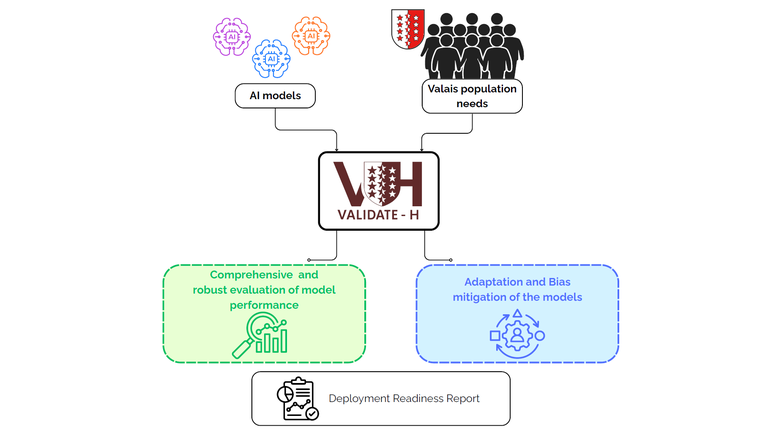
The aim of the project was to verify whether AI systems developed using datasets from abroad remain reliable, fair, and clinically relevant when applied to patients in Valais. To address this challenge, the consortium developed an evaluation framework to assess the performance of AI systems on local data. The framework helped identify potential biases and provided healthcare professionals with the information that can support a safe and equitable use of these AI technologies.
The project focused on two medical imaging applications that reflect common clinical challenges: chest X-rays for detecting cardiomegaly (an enlarged heart) and pleural effusion (fluid around the lungs), and chest CT scans for detecting a broader range of lung abnormalities. Results showed that AI models developed using datasets from abroad can exhibit important performance differences across patient groups, even when their overall accuracy remains high. For example, the models showed lower performance for some demographic groups, including men and patients aged 40 years or younger. Without local validation, such disparities could have gone unnoticed, potentially posing a risk to patient care.
These findings demonstrate that AI models should be tested and adapted in the healthcare environments where they will be used to ensure they provide accurate and fair support for all patients. Predictive performance alone is not enough to establish trust in AI systems. VALIDATE-H used then explainability methods to check whether model predictions were based on clinically relevant information rather than unrelated factors such as patient demographics or image acquisition settings. The consortium also explored DEXiRE-EVO, a model-agnostic approach that generates interpretable decision rules to improve the transparency of complex AI models.
Explainability is thus used as an additional validation instrument: performance metrics indicate how well a model predicts. At the same time, explanations provide complementary evidence about how those predictions are produced and may reveal hidden biases or unstable behavior. Together, these analyses show why AI systems should be evaluated—and, where necessary, adapted—in the clinical environment in which they will be used.
The project supported the Horizon 2030 strategy by promoting more personalized, equitable, and data-driven healthcare. By validating AI tools on local populations, with explainability and population health expertise, the project helped reduce bias, strengthen trust, and support the responsible use of digital health innovations in prevention and health promotion. It also fostered collaboration among healthcare providers, industry, and research institutions, contributing to improved coordination and efficiency in line with Horizon 2030’s vision for cross-sector cooperation.
Project website: https://www.idiap.ch/project/validate-h/
Paper: https://www.melba-journal.org/papers/2025:050.html