The Invisible Threat: Evaluating the Vulnerability of Cross-Spectral Face Recognition to Presentation Attacks
Sep 1, 2025·
 ·
0 min read
·
0 min read
Anjith George
Prof. Sébastien Marcel
Abstract
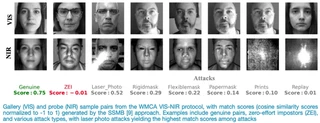
Cross-spectral face recognition systems are designed to enhance the performance of facial recognition systems by enabling cross-modal matching under challenging operational conditions. A particularly relevant application is the matching of near-infrared (NIR) images to visible-spectrum (VIS) images, enabling the verification of individuals by comparing NIR facial captures acquired with VIS reference images. The use of NIR imaging offers several advantages, including greater robustness to illumination variations, better visibility through glasses and glare, and greater resistance to presentation attacks. Despite these claimed benefits, the robustness of NIR-based systems against presentation attacks has not been systematically studied in the literature. In this work, we conduct a comprehensive evaluation into the vulnerability of NIR-VIS cross-spectral face recognition systems to presentation attacks. Our empirical findings indicate that, although these systems exhibit a certain degree of reliability, they remain vulnerable to specific attacks, emphasizing the need for further research in this area.
Type
Publication
International Joint Conference on Biometrics

Authors
Senior Research Scientist
Prof Sébastien Marcel (IEEE Fellow and IAPR Fellow) is a senior research scientist at
the Idiap Research Institute (Switzerland), he heads the Biometrics Security
and Privacy group and conducts research on face recognition, speaker
recognition, vein recognition, attack detection (presentation attacks,
morphing attacks, deepfakes) and template protection. He is also Professor at
the University de Lausanne (UNIL) at the School of Criminal Justice. He is
also the Director of the Swiss Center for Biometrics at Idiap, which conducts
certifications of biometric products. He was Associate Editor and Guest
Editor of IEEE journals (TBIOM, SPL, TIFS and SPM). He is also the lead
Editor of the Springer Handbook of Biometrics Anti-Spoofing (Editions 1, 2
and 3). Since June 2025 he is a member of the Idiap Direction ad interim.