FantasyID: A dataset for detecting digital manipulations of ID-documents
Sep 1, 2025·
,
,
,
 ·
0 min read
·
0 min read
Pavel Korshunov
Amir Mohammadi
Vidit Vidit
Christophe Ecabert
Prof. Sébastien Marcel
Abstract
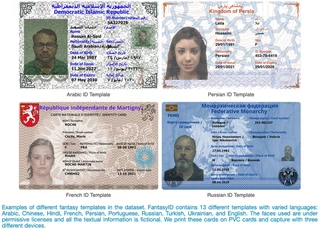
dvancements in image generation led to the availability of easy-to-use tools for malicious actors to create forged images. These tools pose a serious threat to the widespread Know Your Customer (KYC) applications, requiring robust systems for detection of the forged Identity Documents (IDs). To facilitate the development of the detection algorithms, in this paper, we propose a novel publicly available (including commercial use) dataset, FantasyID, which mimics real-world IDs but without tampering with legal documents and, compared to previous public datasets, it does not contain generated faces or specimen watermarks. FantasyID contains ID cards with diverse design styles, languages, and faces of real people. To simulate a realistic KYC scenario, the cards from FantasyID were printed and captured with three different devices, constituting the bonafide class. We have emulated digital forgery/injection attacks that could be performed by a malicious actor to tamper the IDs using the existing generative tools. The current state-of-the-art forgery detection algorithms, such as TruFor, MMFusion, UniFD, and FatFormer, are challenged by FantasyID dataset. It especially evident, in the evaluation conditions close to practical, with the operational threshold set on validation set so that false positive rate is at 10%, leading to false negative rates close to 50% across the board on the test set. The evaluation experiments demonstrate that FantasyID dataset is complex enough to be used as an evaluation benchmark for detection algorithms.
Type
Publication
International Joint Conference on Biometrics

Authors
Senior Research Scientist
Prof Sébastien Marcel (IEEE Fellow and IAPR Fellow) is a senior research scientist at
the Idiap Research Institute (Switzerland), he heads the Biometrics Security
and Privacy group and conducts research on face recognition, speaker
recognition, vein recognition, attack detection (presentation attacks,
morphing attacks, deepfakes) and template protection. He is also Professor at
the University de Lausanne (UNIL) at the School of Criminal Justice. He is
also the Director of the Swiss Center for Biometrics at Idiap, which conducts
certifications of biometric products. He was Associate Editor and Guest
Editor of IEEE journals (TBIOM, SPL, TIFS and SPM). He is also the lead
Editor of the Springer Handbook of Biometrics Anti-Spoofing (Editions 1, 2
and 3). Since June 2025 he is a member of the Idiap Direction ad interim.