Digi2Real: Bridging the Realism Gap in Synthetic Data Face Recognition via Foundation Models

Abstract
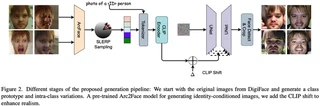
The accuracy of face recognition systems has improved significantly in the past few years, thanks to the large amount of data collected and the advancement in neural network architectures. However, these large-scale datasets are often collected without explicit consent, raising ethical and privacy concerns. To address this, there have been proposals to use synthetic datasets for training face recognition models. Yet, such models still rely on real data to train the generative models and generally exhibit inferior performance compared to those trained on real datasets. One of these datasets, DigiFace, uses a graphics pipeline to generate different identities and different intra-class variations without using real data in training the models. However, the performance of this approach is poor on face recognition benchmarks, possibly due to the lack of realism in the images generated from the graphics pipeline. In this work, we introduce a novel framework for realism transfer aimed at enhancing the realism of synthetically generated face images. Our method leverages the large-scale face foundation model, and we adapt the pipeline for realism enhancement. By integrating the controllable aspects of the graphics pipeline with our realism enhancement technique, we generate a large amount of realistic variations— combining the advantages of both approaches. Our empirical evaluations demonstrate that models trained using our enhanced dataset significantly improve the performance of face recognition systems over the baseline.
Type
Publication
IEEE/CVF Winter Conference on Applications of Computer Vision Workshop

Authors
Senior Research Scientist
Prof Sébastien Marcel (IEEE Fellow and IAPR Fellow) is a senior research scientist at
the Idiap Research Institute (Switzerland), he heads the Biometrics Security
and Privacy group and conducts research on face recognition, speaker
recognition, vein recognition, attack detection (presentation attacks,
morphing attacks, deepfakes) and template protection. He is also Professor at
the University de Lausanne (UNIL) at the School of Criminal Justice. He is
also the Director of the Swiss Center for Biometrics at Idiap, which conducts
certifications of biometric products. He was Associate Editor and Guest
Editor of IEEE journals (TBIOM, SPL, TIFS and SPM). He is also the lead
Editor of the Springer Handbook of Biometrics Anti-Spoofing (Editions 1, 2
and 3). Since June 2025 he is a member of the Idiap Direction ad interim.