HyperFace: Generating Synthetic Face Recognition Datasets by Exploring Face Embedding Hypersphere
Apr 1, 2025·
 ·
0 min read
·
0 min read
Hatef Otroshi Shahreza
Prof. Sébastien Marcel
Abstract
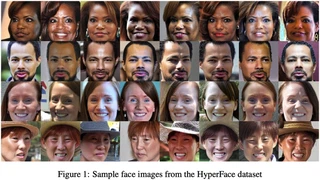
Face recognition datasets are often collected by crawling Internet and without individuals’ consents, raising ethical and privacy concerns. Generating synthetic datasets for training face recognition models has emerged as a promising alternative. However, the generation of synthetic datasets remains challenging as it entails adequate inter-class and intra-class variations. While advances in generative models have made it easier to increase intra-class variations in face datasets (such as pose, illumination, etc.), generating sufficient inter-class variation is still a difficult task. In this paper, we formulate the dataset generation as a packing problem on the embedding space (represented on a hypersphere) of a face recognition model and propose a new synthetic dataset generation approach, called HyperFace. We formalize our packing problem as an optimization problem and solve it with a gradient descent-based approach. Then, we use a conditional face generator model to synthesize face images from the optimized embeddings. We use our generated datasets to train face recognition models and evaluate the trained models on several benchmarking real datasets. Our experimental results show that models trained with HyperFace achieve state-of-the-art performance in training face recognition using synthetic datasets.
Type
Publication
International Conference on Learning Representations

Authors
Senior Research Scientist
Prof Sébastien Marcel (IEEE Fellow and IAPR Fellow) is a senior research scientist at
the Idiap Research Institute (Switzerland), he heads the Biometrics Security
and Privacy group and conducts research on face recognition, speaker
recognition, vein recognition, attack detection (presentation attacks,
morphing attacks, deepfakes) and template protection. He is also Professor at
the University de Lausanne (UNIL) at the School of Criminal Justice. He is
also the Director of the Swiss Center for Biometrics at Idiap, which conducts
certifications of biometric products. He was Associate Editor and Guest
Editor of IEEE journals (TBIOM, SPL, TIFS and SPM). He is also the lead
Editor of the Springer Handbook of Biometrics Anti-Spoofing (Editions 1, 2
and 3). Since June 2025 he is a member of the Idiap Direction ad interim.