Idiap and HEP Valais Join Forces to Prepare Future Teachers Understand and Use AI in Education
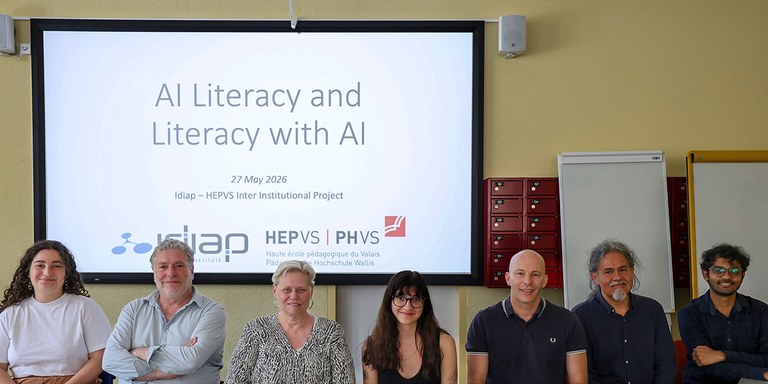
At a time when artificial intelligence is playing an increasingly important role in society, education is one of the fields most directly affected. The “AI Literacy and Literacy with AI” project, led by Professor Daniel Gatica-Perez, head of the Social Computing Group at Idiap, in collaboration with Idiap’s group leader Dr. André Freitas, explores this changing educational context. Conducted in partnership with a team of subject-didactics researchers and educators in Digital Education at the HEP Valais, led by LEAN Lab head, Fabrice Holzer, the project aimed to assess the degree of AI-related digital literacy among HEP students, while also examining how AI could be meaningfully integrated into the AI Literacy training in the teacher’s educational ecosystem of the canton of Valais. PhD student Ravinithesh Annapureddy and R&D engineer Imen Ben Mahmoud complemented the research team at Idiap.
The project was carried out in several stages. An initial assessment analyzed HEP Valais students’ knowledge and use of AI, particularly through questions about the tasks for which they use these tools in their daily practice. Follow-up participatory workshops deepened the understanding of the needs and challenges of the future teachers. The findings highlighted several key needs: gaining a better understanding of how generative AI works, learning how to verify the reliability of AI-generated responses, understanding the underlying principles of these systems, and developing ethical and responsible uses of these technologies.
In a second phase, the research team collaborated to co-design educational modules focused on digital literacy in generative artificial intelligence, for the specific HEP Valais context. These modules then underwent prototyping and testing phases along with the HEP Valais students, supported by Idiap’s advanced technologies and expertise in natural language processing (NLP), in order to evaluate their relevance and applicability in real educational contexts. The training modules also included a hands-on component in which students experimented with an agentic AI system for session planning allowing them to connect abstract AI literacy concepts with concrete teaching situations.
“This project has carved out a lasting path of transdisciplinarity between the so-called hard sciences on the one hand and the social and educational sciences on the other. At a time when many of the traditional reference points that once helped us make sense of the world are being called into question, our research teams have succeeded in exploring together a largely uncharted avenue at the intersection of innovation, research, and education in practice. In doing so, we have fostered a living and meaningful dialogue between theory and practice, between conceptual frameworks and their real-world manifestations. Today, we are convinced that this exploration at the crossroads of multiple disciplines, perspectives, and worlds must continue. More than that, we believe it is necessary”, shares Fabrice Holzer.
“The indiscriminate use of AI has to be challenged. The project has been an opportunity to reflect and work together, identifying both real needs and meaningful technology uses that serve the HEP Valais community. We hope to continue this collaboration, aligned with the mission of Idiap’s Center for Participatory AI” adds Daniel Gatica-Perez.
The project helped HEP Valais’ future teachers gain a better understanding of the fundamentals of artificial intelligence, such as Language Models and generative AI, and support their ability to critically assess its use in teaching contexts. It also introduced a participatory approach for designing and training for AI Literacy that considers students’ actual needs and real-world uses. Finally, it led to the creation of a training framework combining fundamental concepts, ethical considerations, and practical applications through a lesson-planning agentic system.
This project was supported by the interinstitutional project funding call of the Canton of Valais, Department of Economy and Education, Higher Education Service.