Review of Demographic Fairness in Face Recognition
Aug 21, 2025· ·
0 min read
·
0 min read
Ketan Kotwal
Prof. Sébastien Marcel
Abstract
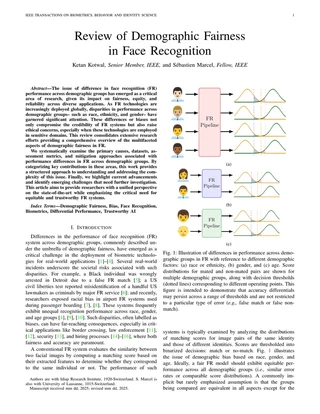
The issue of difference in face recognition (FR) performance across demographic groups has emerged as a critical area of research, given its impact on fairness, equity, and reliability across diverse applications. As FR technologies are increasingly deployed globally, disparities in performance across demographic groups– such as race, ethnicity, and gender– have garnered significant attention. These differences or biases not only compromise the credibility of FR systems but also raise ethical concerns, especially when these technologies are employed in sensitive domains. This review consolidates extensive research efforts providing a comprehensive overview of the multifaceted aspects of demographic fairness in FR. We systematically examine the primary causes, datasets, assessment metrics, and mitigation approaches associated with performance differences in FR across demographic groups. By categorizing key contributions in these areas, this work provides a structured approach to understanding and addressing the complexity of this issue. Finally, we highlight current advancements and identify emerging challenges that need further investigation. This article aims to provide researchers with a unified perspective on the state-of-the-art while emphasizing the critical need for equitable and trustworthy FR systems.
Type
Publication
IEEE Transactions on Biometrics, Behavior, and Identity Science

Authors
Senior Research Scientist
Prof Sébastien Marcel (IEEE Fellow and IAPR Fellow) is a senior research scientist at
the Idiap Research Institute (Switzerland), he heads the Biometrics Security
and Privacy group and conducts research on face recognition, speaker
recognition, vein recognition, attack detection (presentation attacks,
morphing attacks, deepfakes) and template protection. He is also Professor at
the University de Lausanne (UNIL) at the School of Criminal Justice. He is
also the Director of the Swiss Center for Biometrics at Idiap, which conducts
certifications of biometric products. He was Associate Editor and Guest
Editor of IEEE journals (TBIOM, SPL, TIFS and SPM). He is also the lead
Editor of the Springer Handbook of Biometrics Anti-Spoofing (Editions 1, 2
and 3). Since June 2025 he is a member of the Idiap Direction ad interim.